





News Release
February 19, 2026
Canon Inc.
Canon helps advance supply‑chain decarbonization by calculating product CO2 emissions based on actual data using Japan's first SuMPO EPD in the field of virgin-plastic materials, in collaboration with a supplier
TOKYO, February 19, 2026—Canon Inc. announced that, in collaboration with Teijin Limited ("Teijin"), it has helped promote rules for calculating CO2 emissions from virgin plastics using primary data under the SuMPO Environmental Label Program administered by the Sustainable Management Promotion Organization (SuMPO).1 Through this initiative, Teijin obtained the first-ever SuMPO Environmental Product Declaration (SuMPO EPD) certification in Japan for this category.2 In response, Canon incorporated Teijin's actual environmental data—such as CO2 emissions from its plastic materials—into the life-cycle CO2 calculations of its own products, and subsequently registered and disclosed its own SuMPO EPD.2

The SuMPO EPD is a framework that quantitatively discloses environmental information throughout the entire life-cycle of registered products in conformance with ISO 14025. Although this type of framework is becoming more widely adopted, a key challenge has been that CO2 emissions for conventional plastic materials have relied on industry-average emission factors, making it difficult to accurately reflect the emissions-reduction efforts undertaken by individual suppliers. To address this issue, Canon and Teijin worked together and discussed with SuMPO to make available the calculation rule of CO2 emissions (Product Category Rule (PCR)), using primary supplier-specific data, for the virgin plastic material under the SuMPO EPD framework. Based on this initiative, Teijin calculated CO2 emissions and other information relating to its plastic materials using actual operational data and registered the first SuMPO EPD in this materials category.3
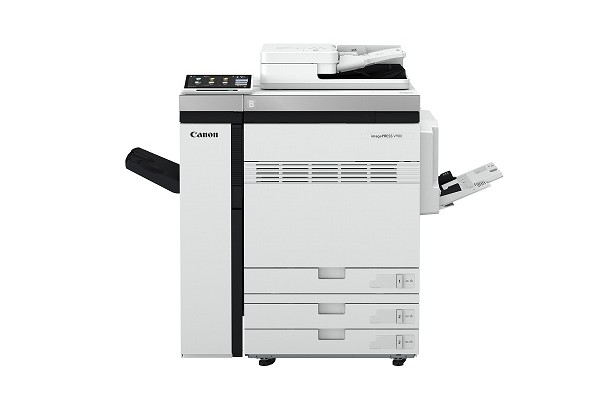
Furthermore, Canon incorporated the primary emissions data for these plastic materials into the life-cycle CO2 emissions calculations for two Canon products,4 one of which is the imagePRESS V900 commercial production printer. SuMPO EPDs for these products have been registered and made publicly available.
As a result of this initiative, a foundation has been established in order to more accurately reflect suppliers’ emissions-reduction efforts in CO2 emissions calculations. In addition, the development of standardized calculation rules for the virgin plastic materials category will enable other companies and organizations to conduct emissions calculations using primary data and is expected to accelerate efforts to reduce CO2 emissions across the entire supply chain.
Calculations made by Canon indicate that CO2 emissions associated with Canon’s overall procurement of raw materials and components are expected to be reduced by up to approximately 2.8 percentage points compared with CO2 emissions calculated using industry-average emission factors.5
Going forward, Canon will expand the scope of raw materials and components subject to primary-data-based CO2 emissions calculations beyond the plastic materials category. Through collaboration with a broader range of suppliers, Canon will continue to promote initiatives to calculate emissions based on actual operational data.
In addition, by progressively expanding the range of products for which supplier-provided primary data on raw materials and components is incorporated into life-cycle CO2 emissions calculations, Canon aims to advance decarbonization across the entire supply chain.
- 1
An international framework administered by SuMPO that quantitatively calculates, verifies, and discloses environmental information on products using the life cycle assessment (LCA) method
- 2
SuMPO EPD Register Numbers: JR-AI-25421E, JR-AI-25422E, JR-AI-25423E, JR-AI-25424E
- 3
As of February 19, 2026 (according to research by Canon)
- 4
imagePRESS V900 and imagePRESS V800
- 5
Estimated value calculated based on the volume of transactions for Teijin-manufactured plastic materials in 2025 (as of November 2025), according to Canon research
Canon Group Environmental Targets
Canon works to protect and conserve the global environment in line with the Canon Group Environmental Vision. With regard to climate change measures, Canon aims to achieve net-zero GHG emissions throughout product life cycles (Scope 1, 2, and 3) by 2050. To achieve this goal, the company has set science-based GHG emissions reduction targets in line with SBTi standards: by 2030, a 42% reduction in Scope 1 and 2 emissions and a 25% reduction in Scope 3 emissions (Category 1 and 11) compared to 2022 levels.1,2 In 2008, Canon set an overall environmental target of achieving an average annual improvement of 3% in the life‑cycle CO2 emissions improvement index per product unit. As a result, against this target, Canon has realized an average annual improvement of 3.76% between 2008 and 2024, and a total improvement of 44.6% since 2008.
- 1
SBTi (Science Based Targets initiative) is an international initiative to encourage companies to set greenhouse gas emission reduction targets based on climate science. It is jointly managed by four organizations: United Nations Global Compact (UNGC), World Resources Institute (WRI), Worldwide Fund for Nature (WWF) and CDP.
- 2
Scope 1: Direct emissions (city gas, LPG, diesel, kerosene, non-energy greenhouse gases, etc.); Scope 2: Indirect emissions (electricity, steam, etc.); Scope 3: Emissions in the supply chain, Category 1: Purchased goods and services; Category 11: Use of sold products.