





News Release
February 6, 2026
Canon Inc.
Canon launches "Smart Support Chat" to enhance office printer maintenance services and streamline field operations through an AI-driven agent harnessing a wide range of field expertise
TOKYO, February 6, 2026—Canon Inc. announces the introduction of Smart Support Chat, an AI-based support system designed to streamline maintenance operations for office multifunction devices (MFDs). The system has already been introduced in parts of Europe, Asia, and Oceania, with plans to expand it to the United States and Japan in 2026.
Canon has long been committed to improving the efficiency of maintenance and support operations performed by call center staff and on-site service engineers. To date, the company has enhanced the durability and overall quality of its MFDs to reduce failure rates, and refined product designs to simplify on-site tasks such as installation and parts replacement. However, achieving further productivity gains in the field requires not only better products but also a support system that enables maintenance staff to perform their tasks more efficiently and with higher quality.
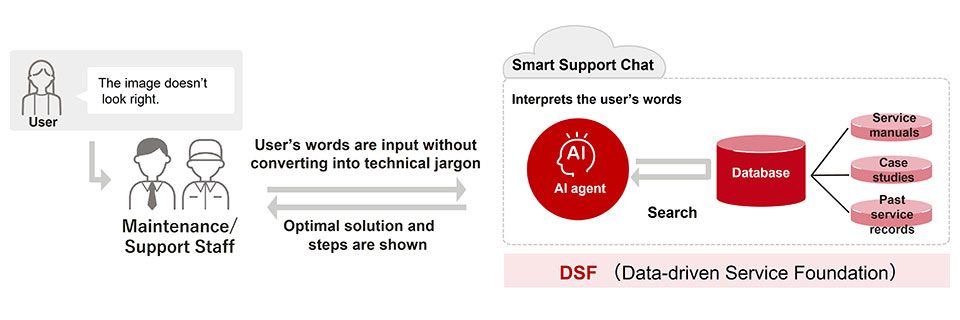
The Smart Support Chat addresses this need by serving as a work assist system that integrates service manuals, accumulated field know-how, and real-time device operating data to analyze user-reported issues—entered by maintenance and support staff on a PC or smartphone—and identify the likely cause of the problem and recommend appropriate corrective actions. By using this system, both call center staff who receive inquiries from users and service engineers who subsequently visit customer sites can respond more quickly, thereby further reducing device downtime.
The system generates high-quality, relevant responses to a wide range of issues, such as paper jams and print‑quality defects, that each require different types of specialized knowledge. To make this possible, Canon developed a proprietary AI agent. By leveraging generative AI technology, the AI agent can directly understand user spoken descriptions—such as “The image does not look right”—without requiring them to be converted into technical jargon. The system then searches a vast database of more than 120,000 service manuals, case studies, and past service records accumulated by Canon over the years to generate its responses. Even when the necessary information appears unrelated to the issue at first glance, the system can associate the problem with the relevant technical terminology, retrieve the appropriate information from the database, and determine and present appropriate corrective actions.
This is made possible by the logic embedded by Canon’s development team—experts deeply familiar with the company’s multifunction devices—which enables the system to analyze the data and guide it toward the correct solution.
The system operates on the Data-driven Service Foundation (DSF), Canon’s service platform that collects operating data from printers, including multifunction devices, and provides services that enable more efficient maintenance and support operations. It even enables remote access to the operation panel of an active MFD, allowing technicians to perform operations remotely, as well as check real‑time status of parts and consumables.
Through this system and the remote access function, Canon expects to reduce annual service‑engineer dispatches by approximately 5% in regions where Smart Support Chat is deployed.* Looking ahead to 2028, Canon aims to further reduce it to around 20%, supported by further improvements in device quality and an expanded dataset powering the system.
Canon will continue advancing the development and operation of diverse AI-based tools, delivering AI‑driven solutions not only for maintenance and service operations but across a wide range of business domains.
- *
Estimate based on Canon’s analysis of service‑engineer dispatch records in 2024 within Canon Group regions targeted for Smart Support Chat deployment