




News Release
May 13, 2026
Canon Inc.
Kyoto Culture Association (NPO)

The Tsuzuri Project donates high-resolution facsimile of 16-century artwork by Sesson Shukei to Fukushima Prefecture
TOKYO, May 13, 2026— Canon Inc. announced today that the Tsuzuri Project (officially, the Cultural Heritage Inheritance Project), a joint project organized by Canon and the Kyoto Culture Association (NPO), will donate a high-resolution facsimile of Egrets in Plum and Willow by Sesson Shukei to Fukushima Prefecture. The facsimile was created as part of the Tsuzuri Project, a joint initiative of Canon and the Kyoto Culture Association. The original artwork is housed at the Minneapolis Institute of Art in the United States.
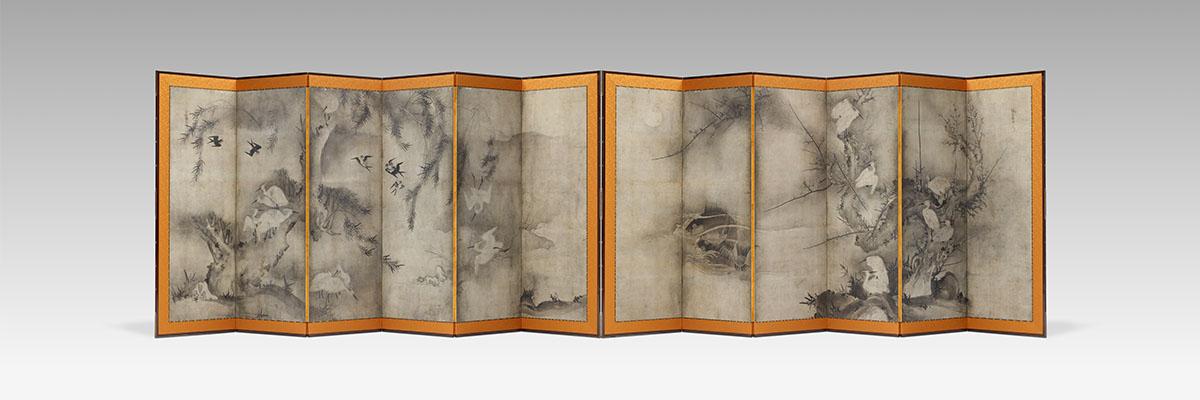
Minneapolis Institute of Art, gift of funds from Mr. and Mrs. Richard P. Gale 65.7.1-2
Sesson Shukei was a painter-monk active primarily in eastern Japan between the 15th and 16th centuries. Known for his highly original and unconventional style, he produced numerous works while traveling widely across the Tohoku and Kanto regions, including present-day Fukushima Prefecture. Egrets in Plum and Willow is regarded as one of the most significant examples of his works. The original composition consists of a pair of ink paintings on paper mounted on six-paneled folding screens. It is thought to date from the artist’s later years and reflects the mature style for which he is known.
To create the facsimile, Canon photographed the original artwork using a full-frame mirrorless camera, then processed the data with its proprietary color-matching system before printing the images on washi paper using 12-color Canon inkjet printers. Master artisans in Kyoto then mounted the prints onto folding screens using traditional techniques, achieving a faithful reproduction that preserves both the visual qualities and physical presence of the original.
A presentation ceremony will be held on May 29 at the Fukushima Prefectural Museum—where the facsimile will be stored following the donation—along with a public talk at which representatives of Canon and the Kyoto Culture Association will explain the Tsuzuri Project and the work itself, and discuss the history of the Aizu area, where Sesson lived for a time. The facsimile will be displayed in the museum’s entrance hall from May 30 to June 21. Visitors will be able to view the facsimile up close without a protective glass case, and photography will be permitted. A concurrent exhibition will feature works by painters and other artists associated with the region, including Sesson, in the museum’s collection.1 The facsimile is scheduled to be used in a variety of exhibitions, events, and educational programs at the museum.
About the Tsuzuri Project
Launched in 2007, the Tsuzuri Project is a joint cultural initiative organized by Canon and the Kyoto Culture Association. The project involves producing high-resolution facsimiles of historical artworks by combining Canon’s technical expertise in imaging, processing, and printing with the master craftsmanship of traditional Kyoto artisans. These high-resolution facsimiles are donated to shrines, temples, local governments, museums, and other organizations where they are made available for public display, education, and other purposes. So far, more than 60 high-resolution facsimiles of works by artists including Katsushika Hokusai, Tawaraya Sotatsu, and Ogata Korin have been created.
For more information, please visit the Tsuzuri Project webpage: https://global.canon/en/tsuzuri/
- 1
For details about the exhibition, please visit the official homepage of the Fukushima Prefectural Museum: https://art-museum.fcs.ed.jp/English