






News Release
October 15, 2026
Canon Inc.
Canon conducts a volumetric video demonstration for large-scale, simultaneous transmission of an international sports event
TOKYO, October 15, 2026—Canon Inc. announced today that in late September it conducted a demonstration in which 3D spatial data of a basketball game at an international sports event held in Japan, captured and generated using volumetric video technology, was streamed live1 through a cloud distribution platform to individual devices. The experiment marked the world's first2 initiative to capture a sports competition in volumetric video and transmitted it as 3D spatial data, allowing a large number of spectators to view the event simultaneously.
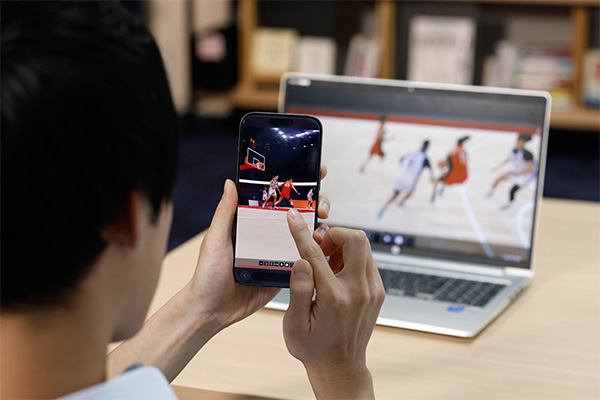
Volumetric video involves filming a location using approximately 100 cameras simultaneously and converting the entire space to 3D data. Canon has so far deployed this technology across a wide range of fields from live sports broadcasts to concert livestreams. By delivering the 3D spatial data generated with this technology to individual devices over the internet, viewers can enjoy watching sports while freely controlling their viewpoints. However, because 3D spatial data is extremely large in volume, livestreaming it to a large number of viewers had been difficult.
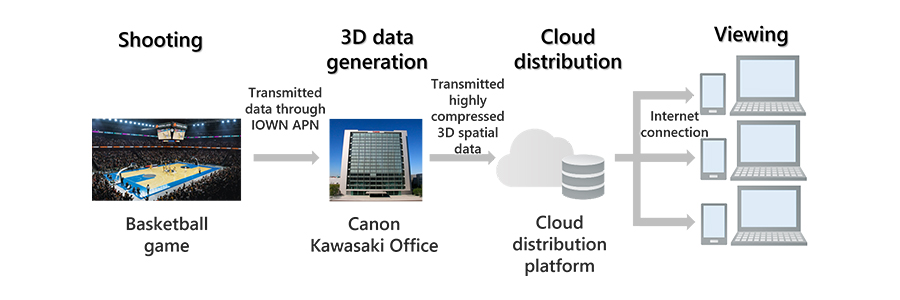
In the demonstration, footage from the competition venue was transmitted to Canon’s Kawasaki Office, where 3D spatial data was generated in real time, efficiently compressed, and streamed live to a large audience via a cloud-based distribution platform. As a result, Canon was able to support simultaneous viewing from approximately 750 devices. This allowed participants to freely control their viewpoints, such as an overhead view of the entire court or a close-up view of the athletes, while watching the game.
In recent years, amid the diversification of sports viewership, there has been increasing demand for interactive viewing experiences that can effectively captivate viewers. Although volumetric video technology has been used mainly for broadcasting content such as highlights during live broadcasts up until now, this demonstration offered viewers a personalized live viewing experience in which each person could freely choose their own viewpoint and follow the action from any angle, illustrating the potential for additional ways of watching sports.
The IOWN3 All-Photonics Network (APN), a next-generation communications infrastructure led by NTT, was used to transmit the data from the sports arena to the Kawasaki Office. Going forward, Canon will continue to advance volumetric video technology through collaboration with partner companies and facility operators, while working to create new value in sports viewing experiences.
- 1
The time from capture to video display on each participant’s device was approximately 16 seconds.
- 2
As of October 14, 2026 (according to a survey by Canon)
- 3
IOWN is a network and information-processing platform, including connected devices, that draws on all available data to optimize both individual users and society collectively, while harnessing cutting-edge optical technologies to deliver ultra-high-speed communications and enormous computing resources.