






News Release
November 25, 2026
Canon Inc.
Canon to debut Ultimion Photon-Counting CT at RSNA 2026, advancing clinical evidence
TOKYO, Nov 25, 2026—Canon Inc. today announced it will showcase its photon-counting CT (PCCT) system, Ultimion, at the annual meeting of the Radiological Society of North America (RSNA 2026), to be held in Chicago from November 29 to December 3, 2026. The showcase represents a new phase in research using the Ultimion in which organizations are advancing broad clinical evaluations and evidence generation. Canon will also present these initiatives and research findings at RSNA 2026.
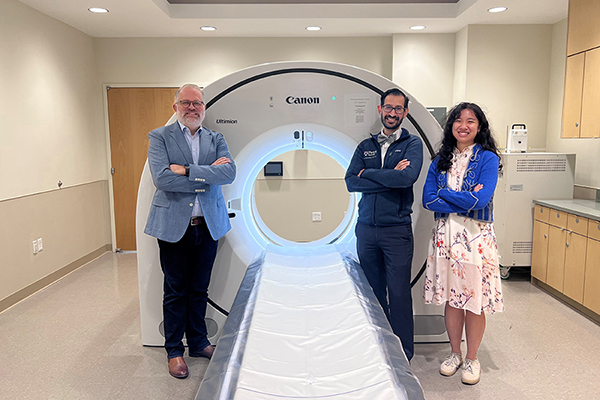
Peter B. Noël, PhD; Ali H. Dhanaliwala, M.D., PhD; Leening P. Liu, PhD
Ultimion is Canon’s next-generation CT system that combines photon-counting detector technology with advanced image reconstruction and workflow innovations, enabling Always ON ultra-high-resolution and spectral imaging capabilities in a single acquisition. Designed to support low-dose imaging, diagnostic confidence, and workflow productivity, the system also incorporates INSTINX data-processing and automation technology developed to streamline the integration of photon-counting CT into everyday clinical practice. Following its product announcement in Japan in April 2026, RSNA 2026 will mark the first international exhibition appearance of Ultimion. At its booth, Canon will highlight the system's key features and selected clinical cases.
Canon has been working with medical and academic institutions in Japan and around the world, including Penn Medicine1, to advance the clinical value of photon-counting CT. Penn Medicine and Canon have jointly conducted research on photon-counting CT for several years, with Penn researchers and Canon scientists working side by side on study design, protocol development, image reconstruction, and clinical evaluation, particularly in the area of ultra-high-resolution imaging. Penn Medicine has been a central partner in this program, contributing to studies in cardiovascular imaging, dose efficiency, spectral imaging, ultra-high-resolution imaging, and other clinical applications. Together, the teams have generated clinical evidence and physics data on photon-counting CT, and findings from the joint work have been presented at RSNA and other major international scientific congresses.
Installed at Penn Medicine in May 2026, Ultimion reflects knowledge gained through years of collaborative research and became the first Canon commercial PCCT system to undergo clinical evaluation in the United States after receiving regulatory approval in Japan. While awaiting U.S. FDA clearance, research is underway to evaluate the system across a broad range of clinical applications and generate additional clinical evidence. Insights gained through these efforts are expected to contribute to the further expansion of photon-counting CT applications and support the future global deployment of Ultimion, including in the United States.
Toshio Takiguchi, Executive Vice President of Canon Inc., commented:
“We are very pleased to further advance our collaboration with Penn Medicine. The knowledge gained through this research will help expand the clinical applications of photon-counting CT and contribute to its broader adoption in clinical practice, ultimately benefiting both healthcare professionals and patients.”
“Building on our long-standing research in photon-counting CT, we are now evaluating this technology across a broad range of applications. Features such as ultra-high resolution, combined with advanced reconstruction methods, can extend the clinical capabilities we offer our patients. We expect photon-counting CT to become a mainstay of clinical practice,” said Peter B. Noël, PhD, Professor of Radiology, Chief Technology Officer of One Penn Radiology, and Director of CT Research at the Perelman School of Medicine at the University of Pennsylvania.
“We have been very pleased with the high-resolution image quality that Ultimion delivers with full detector width acquisition in cardiovascular imaging, particularly in patients with heavy calcification and stents, where conventional CT reaches its limits,” said Harold I. Litt, MD, PhD, Professor of Radiology at the Perelman School of Medicine at the University of Pennsylvania.
“We value our research collaboration with Canon and the partnership it reflects, and we look forward to seeing the field of photon-counting CT expand further,” said Pari Pandharipande, MD, MPH, Eugene P. Pendergrass Professor & Chair of Radiology at the Perelman School of Medicine at the University of Pennsylvania.
- 1
Penn Medicine is an integrated healthcare group comprising the University of Pennsylvania School of Medicine and the University of Pennsylvania Health System, a network of medical facilities centered on the Hospital of the University of Pennsylvania.