




Biodiversity
Efforts Towards Achieving Nature Positive
Biodiversity refers to the way living things interact as they coexist on earth. Within this sphere, birds occupy the top position in a local ecosystem pyramid of plants, insects, and small animals, symbolizing the cycle of life. Emblematic of our activities based on the Canon Group Biodiversity Policy is the Bird Branch Project, which Canon has been promoting since 2015. The project encompasses a range of bird-centered activities at operational sites in Japan and overseas.
By 2026, we would like to expand the number of sites participating in the project, from one head office in Shimomaruko (2015) to 60 all over Japan and overseas, and strengthen our efforts.
Response to TNFD
Canon believes that actions to conserve biodiversity will prevent the loss of economic activity, create jobs and business, and lead to Canon’s sustainable development. For this reason, we are currently assessing issues related to the natural environment, including our dependence on natural capital and our impact on such capital, and are steadily increasing our disclosure on these issues in accordance with the framework of the Task Force on Nature-related Financial Disclosures (TNFD).
Initiatives in 2025
Canon took part in the TNFD Forum in 2025 to gather information on the Taskforce’s initiatives. Also, in line with the LEAP (Locate, Evaluate, Assess, Prepare) approach, we initiated the Locate phase of analyzing our main operational sites and marketing and production sites (80 locations in Japan and overseas), targeting direct operations.
Analysis of Interface with Nature (Locate)
We used the ENCORE* tool to assess the dependencies and impacts on nature in each of Canon’s business sectors. By creating and scoring a heat map, we found that several businesses have relatively high dependencies and impacts on nature.
We also assessed ecologically sensitive locations based on the location information of the sites. Under the definition of sensitive locations (see table at right), we used the analytical tools below to score five items. This allowed us to understand the ecological dependency and impact of the various sites.
- * Exploring Natural Capital Opportunities, Risks and Exposure (ENCORE): A nature-related risk management tool that can assess dependencies and impacts on nature for each type of economic activity.
Definition of Sensitive Locations
- Areas of biodiversity importance
- Areas with high ecosystem integrity
- Areas where ecosystem integrity is declining rapidly
- Areas with high water physical risks
- Areas where ecosystem services provided are important, including benefits to indigenous communities, local communities and stakeholders
Analytical tools for sensitive locations
- IBAT*1
- WWF Risk Filter Suite (BRF/WRF)*2
- Global Forest Watch*3
- *1 Integrated Biodiversity Assessment Tool (IBAT): A biodiversity assessment tool that integrates global databases such as the IUCN Red List of Threatened Species, the World Database on Protected Areas (WDPA), and the World Database of Key Biodiversity Areas (WDKBA).
- *2 WWF Risk Filter Suite (BRF/WRF): A set of tools for assessing nature-related risks. It consists of two tools: the Biodiversity Risk Filter (BRF), which assesses biodiversity risks, and the Water Risk Filter (WRF), which assesses water risks.
- *3 Global Forest Watch: An online platform that provides data and tools for forest monitoring.
Based on the results obtained and the fact that Canon's manufacturing processes require substantial water resources, we narrowed down priority areas from the 80 sites. As a result, 12 sites were provisionally selected as candidates for priority areas.
However, the assessments provided by the tools are limited to general applications and may not reflect actual conditions in regions where each site is located. Accordingly, we will continue to conduct detailed surveys, evaluating impacts on business and the environment to identify priority locations, while also identifying dependencies, impacts, risks, and opportunities in accordance with the analysis from the Evaluate phase onwards.
Nature Positive Initiatives Around the World
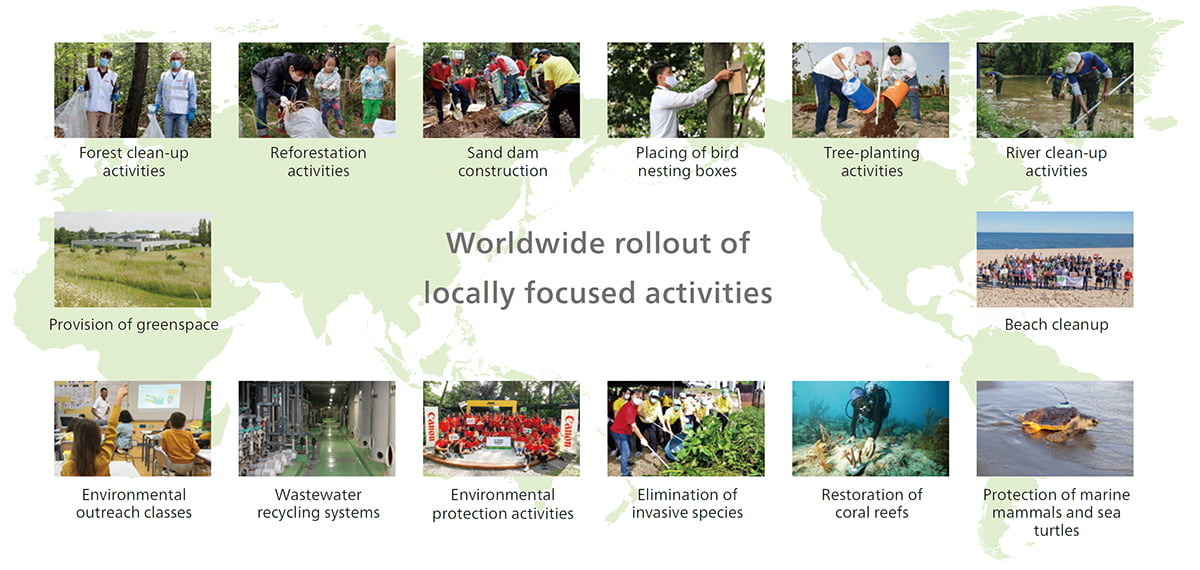
Canon recognizes biodiversity as essential for a sustainable society. We carry out various activities to conserve and protect biodiversity under the Canon Group Biodiversity Policy.
Initiatives to Support Continuous Use of Sustainable Forestry Resources
To help support biodiversity, Canon promotes the use of sustainable forestry resources as the raw materials for the paper used in its products. Having established procurement policies favoring the purchase of paper products derived from sustainably sourced wood pulp in 2015, we sell office paper made under forest certification schemes or using environmentally conscious raw materials.
Basic Policy on the Procurement of Timber Products
Canon Bird Branch Project
Biodiversity refers to the way living things interact as they coexist on earth. Within this sphere, birds occupy the top position in a local ecosystem pyramid of plants, insects, and small animals, symbolizing the cycle of life. Emblematic of our activities based on the Canon Group Biodiversity Policy is the Bird Branch Project, an initiative Canon launched in 2015 that encompasses a range of bird-centered activities. Marking its 10th anniversary, the project has been taken on board by various operational sites in Japan and overseas. For example, Canon's Shimomaruko headquarters complex in Tokyo includes a greenspace with a wide variety of trees that we call the Shimomaruko Woodland. Under the supervision of the Wild Bird Society of Japan, a monthly census of the migration of wild birds is carried out. The number of observed species has grown from 23 in 2014 to 45 as of the end of 2025, indicating the success of our efforts to promote species diversity.

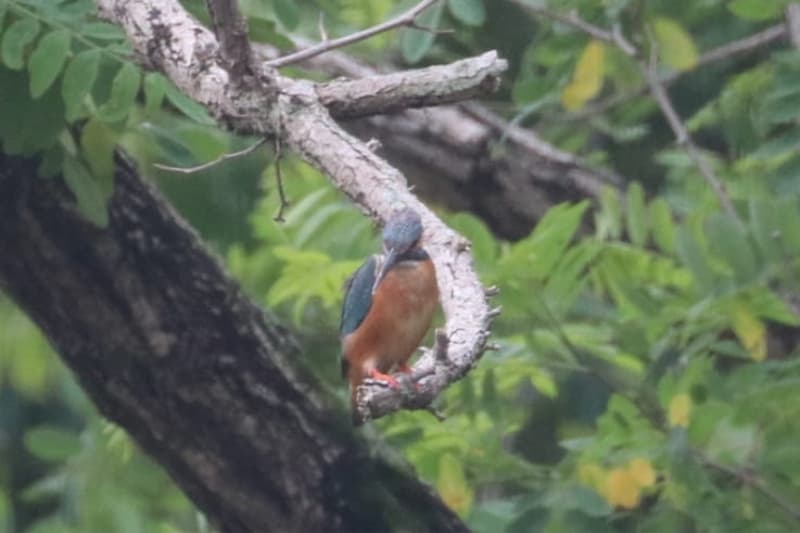
At Canon Ecology Industry, with the support of experts from the Wild Bird Society of Japan, we have been actively working to attract kingfishers to the retention pond at the site since 2020. This has included releasing small fish species such as gudgeon and ginbuna that are common prey for kingfishers, which has resulted in an adult kingfisher being observed at the site.
Oita Canon Materials is pursuing greening activities that pay special attention to harmony with the surrounding environment and Japan’s four seasons. The subsidiary has also installed nesting boxes to create a bird habitat and actively takes part in volunteer activities to clean up the environment around its premises.
Canon Fuji-Susono Research Park properly maintained and managed the green space that covers 88% of the site, as well as planting trees and installing nesting boxes to create an environment hospitable to incoming wild birds. In addition, we conducted local cleanup activities, including areas surrounding the park office, and held on-site environmental classes and career education for elementary and junior high school students.
Canon China held a Bird Branch Photo Exhibition in which employees of Group companies in China were asked to submit photos with a wild bird theme.
The photos were displayed in showrooms in Beijing, Shanghai, Guangzhou and Chengdu. Canon China also actively disseminates information about its activities and bird-watching columns on its website and social media.
At other sites as well, we have created biotopes, with bird baths and nesting boxes installed and kept clean and measures taken to protect against bird strikes, creating on-site environments conducive to bird life. By sharing successful nesting inside nesting boxes and other activities, it gives employees an opportunity to study aspects of the lives of wild birds even in familiar surroundings. Meanwhile, 12 of our operational sites, including Oita Canon Materials, participate in the seasonal wildlife monitoring scheme proposed by the National Institute for Environmental Studies. Participants report the species of bird, plant, reptile, and insect observed at the site as well as the date on which the first birdsong of each species is heard, the date on which it is first seen, and the date on which each tree or plant begins to flower. These data also make a useful contribution to academic studies.
Contribution to the Global "30by30" Target
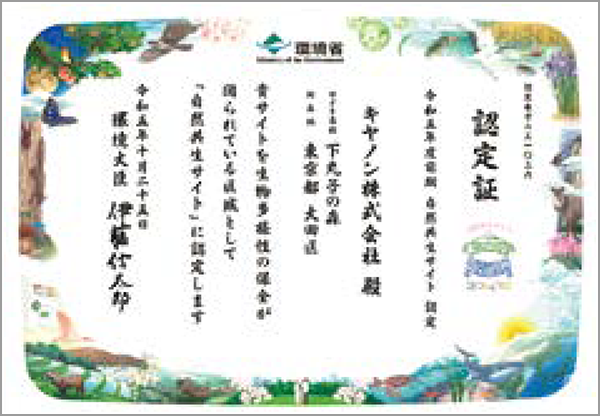
In 2023, a green area on Canon's headquarters grounds, where nearly 1,000 trees of approximately 80 different species have been planted, was certified by Japan's Ministry of the Environment as a Natural Coexistence Site under the name "Shimomaruko no Mori."
This certification program recognizes areas where biodiversity conservation is promoted through private‑sector initiatives and other efforts, supporting the global target known as "30by30," which aims to effectively conserve more than 30% of land and sea areas as healthy ecosystems by 2030. Shimomaruko no Mori was recognized not only for its contribution to local biodiversity conservation but also for its initiatives under the Bird Branch Project.
In addition, Shimomaruko no Mori was registered in an international database as an OECM* in 2024.
Furthermore, the Oita Plant of Oita Canon Inc. and the headquarters of Canon Medical Systems Corporation were certified as Natural Coexistence Sites in 2024, followed by Canon Ecology Industry in 2025.
- * Other Effective area-based Conservation Measures Areas outside protected areas that support biodiversity conservation
The Canon Group Certified as Nature Symbiosis Sites