




Chemical Substances / Pollution Prevention
Management of Chemical Substances used in Manufacturing Processes
The chemical substances handled during manufacturing at Canon include "controlled chemical substances" regulated in terms of safety such as negative impact on human health, the environment, and flammable risk. Canon categorizes these substances and has put effective measures in place for each category.
Classification and Measures for Controlled Chemical Substances in Production Processes
| Classification | Explanation | Response Measures |
|---|---|---|
| A | Substances specified by the Chemical Weapons Convention, the Stockholm Convention, the Montreal Protocol and the Convention concerning Safety in the Use of Asbestos, as well as specified greenhouse gases (PFCs/HFCs/SF6), other soil and groundwater pollutants, and substances that significantly impact people's health | Prohibit use in principle. Only use as an exception when there are no alternatives and the substance is not prohibited by law after applying for and receiving permission, and control the amount used. |
| B | Greenhouse gases other than PFCs/HFCs/SF6, greenhouse gases whose global warming potential (GWP) has been determined by the IPCC, volatile organic compounds (VOCs), and other substances designated by Canon | Aim to reduce use and emissions through substitutions, sealing, recovery, etc. |
| C | Chemical substances with defined compliance requirements, including compliance with reference values and the ascertainment of usage and storage quantities | Manage the amount of use and usage history in accordance with laws. |
Reducing the Usage and Emission of Controlled Chemical Substances in Production Processes
Canon production sites engage in various initiatives to reduce and control emissions of controlled chemical substances shown in the table on the right, including reducing the volume of substances used by improving production processes and reusing the substances. For example, Canon Dalian Business Machines took steps to reuse and recycle solvents, as did Canon Inc., Taiwan, amid other efforts to replace controlled chemical substances with other substances.
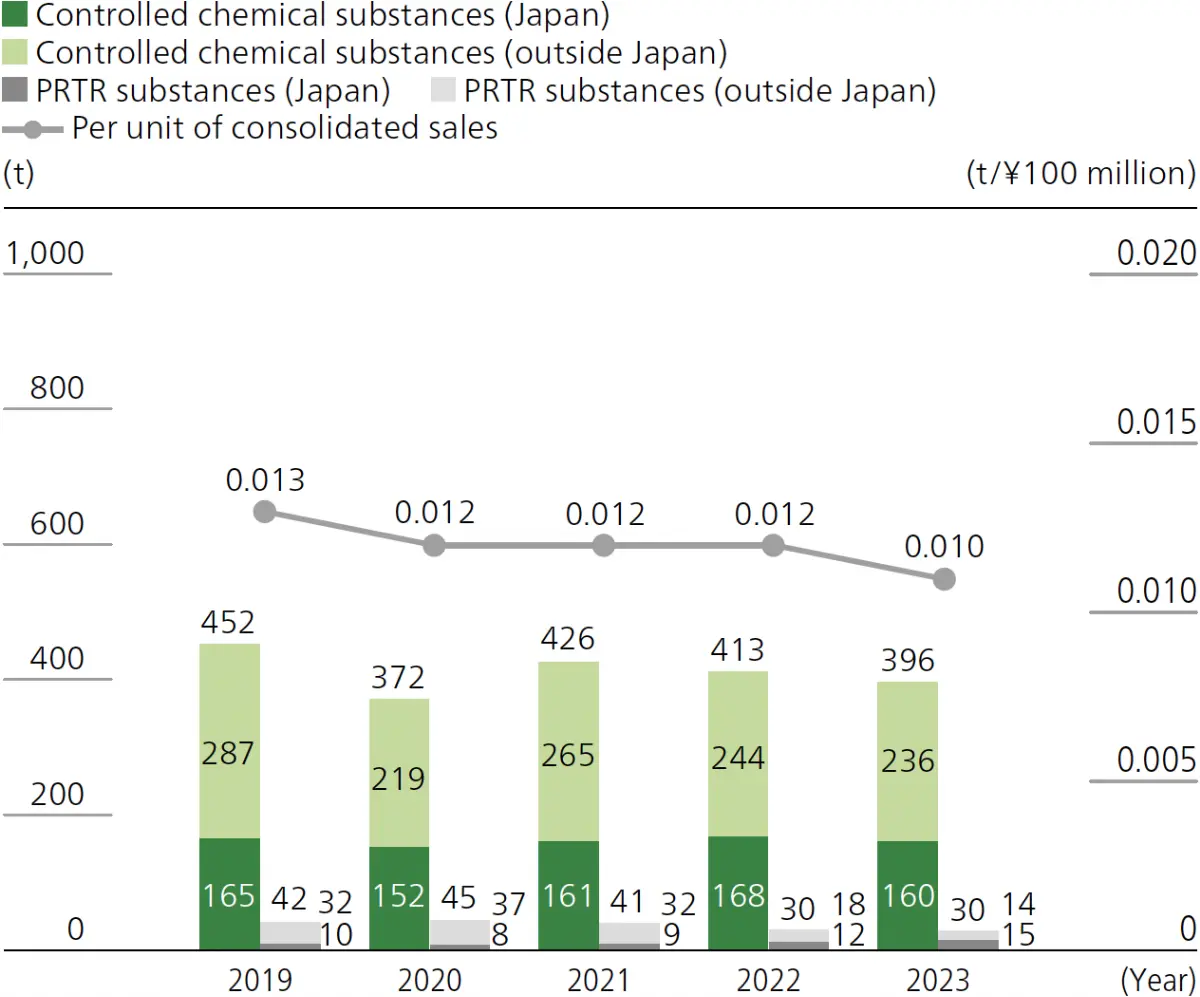
- * PRTR System: Pollutant Release and Transfer Register System, a notification system for the transfer and release of chemical substances.
- * Controlled chemical substances exclude regulated substances.
- * The scope of aggregation mainly includes companies that have acquired ISO 14001 consolidated certification.
Reducing Emissions into the Atmosphere and Waterways and Preventing Pollution
Canon alleviates the environmental impact of its operational sites by reducing emissions of NOx*1 and SOx*2, which are major causes of air pollution and acid rain; reducing discharge of phosphates and nitrogen compounds, which cause the eutrophication of water environments; and, reducing BOD*3 and SS*4, which indicate an environmental impact in water areas.
Canon Components sought to completely eliminate industrial effluent by reducing ink waste and processing it in-house. The company formerly relied on outside contractors to process some of the effluent generated in the ink production process, but by improving cleaning efficiency, it has reduced residual ink by 85% and effluent by 50%. Moreover, we have realized the in-house processing of new ink waste using proprietary coagulation and separation technologies. By successfully improving in-house processing capabilities, the company has also completely eliminating industrial effluent by processing all effluent in-house, significantly reducing the energy required for transport and processing. We will continue to process all ink waste in-house and maintain a sustainable production framework.
To prevent air pollution, when installing or updating equipment that uses fuel, Canon opt for fuels that minimize generation of air pollutants (such as sulfur oxide, nitrogen oxide and soot), and have banned the use of heavy oil in principle. Furthermore, we have designated ozone-depleting substances and persistent organic pollutants cited in the Stockholm Convention on Persistent Organic Pollutants as banned substances. With regard to wastewater, each operational site sets standard values based on local laws and regulations. Also, control values are set at 80% of the standard values as management standards at each site. We regularly check the status of compliance.
- *1 Nitrogen oxides (NOx) A major cause of air pollution, acid rain and photochemical smog, NOx is generated when the nitrogen in fuels is oxidized or when nitrogen in the atmosphere is oxidized during high temperature combustion.
- *2 Sulfur oxides (SOx) A major cause of air pollution and acid rain, SOx is generated when fossil fuels, such as oil and coal, are burned.
- *3 Biochemical oxygen demand (BOD) BOD is the amount of oxygen consumed when microorganisms degrade organic matter in water. Larger figure indicates worse water quality.
- *4 Suspended solids (SS) A collective term used for substances of less than 2 mm in diameter that float in the air and do not dissolve.
Soil and Groundwater Management Status
Placing high priority on soil and groundwater protection, Canon has established an internal Basic Policy on Soil and Groundwater Pollution to guide us as we seek to implement comprehensive response measures. In the unlikely event that soil or groundwater pollution is found at one of our operational sites, cleanup and remedial actions are carried out in close accordance with all relevant laws (see table below). Canon has also adopted, in principle, an internal standard for acquiring new land, conducting a preliminary soil examination and carrying out any other necessary procedures, such as soil remediation, before making the purchase. We also monitor the chemical substances used at each site and, considering applicable national and regional standards, develop risk countermeasures according to the local situation.
PCB Waste Management
In accordance with Japan’s PCB Special Measures Act, at Canon’s domestic production sites, polychlorinated biphenyl (PCB), which may have adverse effects on human health and the environment, is strictly managed. As of December 2025, no operational sites stored highly concentrated PCB waste.
Soil and Groundwater Contamination Management Examples
| Operational Site | Substances | Measures |
|---|---|---|
| Shimomaruko | 1,2-dichloroethylene | Injection of treatment agents, water quality measurement |
| Utsunomiya parking lot 1 | Fluorine and its compounds, etc. | Pumping, water quality measurement |
| Toride | Trichloroethylene, etc. Hexavalent chromium and its compounds |
Covering, pumping, water quality measurement |
| Canon Ecology Industry | Trichloroethylene, 1,1-dichloroethylene | Covering, pumping, water quality measurement |
| Canon Components | Mercury and its compounds | Covering, water quality measurement |
- * Reports are made to the authorities concerning sites where remediation is in progress.