






Capturing light effectively for more reliable optical sensing
Black Anti-Reflective Coating
One key factor that determines the performance of optical devices and sensors is how effectively light reflections can be suppressed. To address this challenge, Canon combined its longstanding expertise in optical and materials technologies to develop a unique black anti-reflective coating that efficiently captures and absorbs unwanted light, thereby minimizing reflections. With potential applications extending beyond cameras to a wide range of devices that use light for detection and measurement, the coating could contribute to more reliable optical sensing. This article explains how the coating works, what sets it apart from other methods, and where the technology could be used.
Table of Contents
What is black anti-reflective coating?
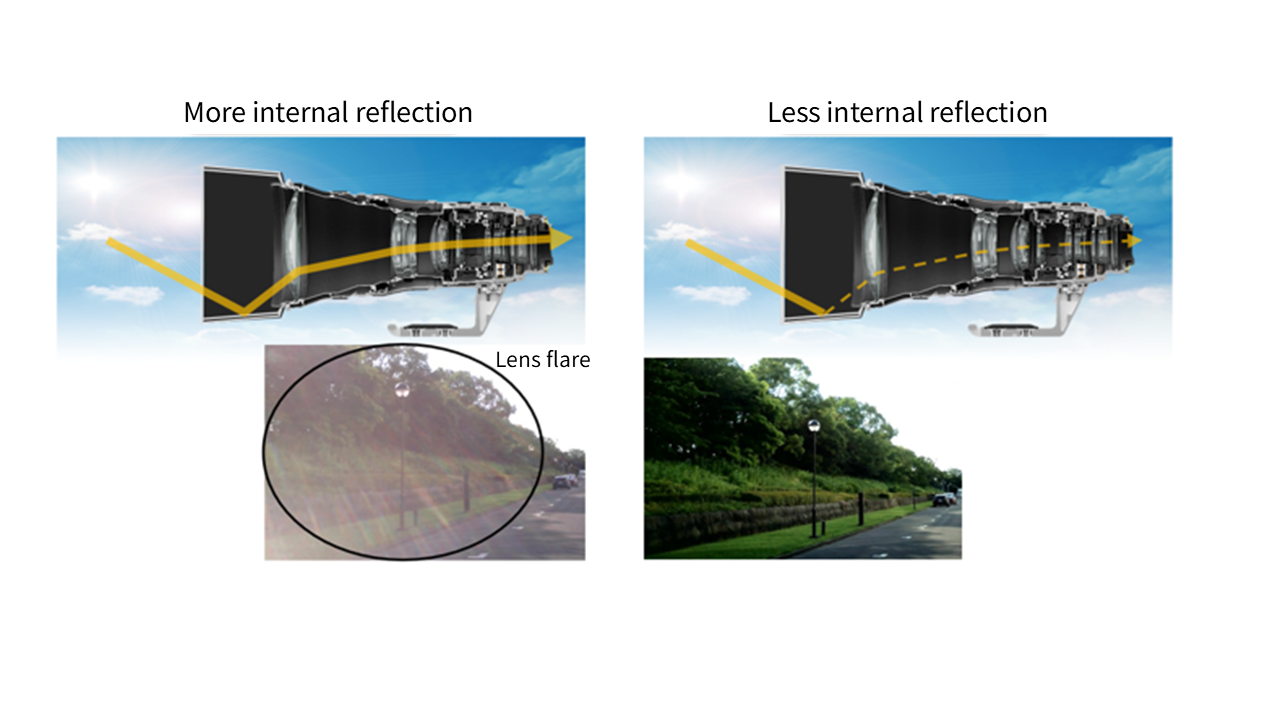
A camera forms an image by directing light, which reflects when it strikes a surface, through the lens onto the image sensor. However, not all of the light entering the lens reaches the sensor as intended. Some is reflected by lens surfaces or internal camera components and may ultimately reach the sensor as stray light, degrading image quality.
There are two main ways to reduce such reflections. One is to absorb the light using a black surface.
The other is to trap light within a surface structure, preventing it from escaping and being reflected back. Typical black anti-reflective coatings work mainly by absorbing light, but it is difficult to form a structure within the coating that effectively captures light, particularly light entering at an oblique angle.
As a result, optical devices such as cameras employ not only black coatings that absorb light, but also techniques such as texturing component surfaces to suppress reflections from light entering at various angles.
Advantages of Canon's black anti-reflective coating
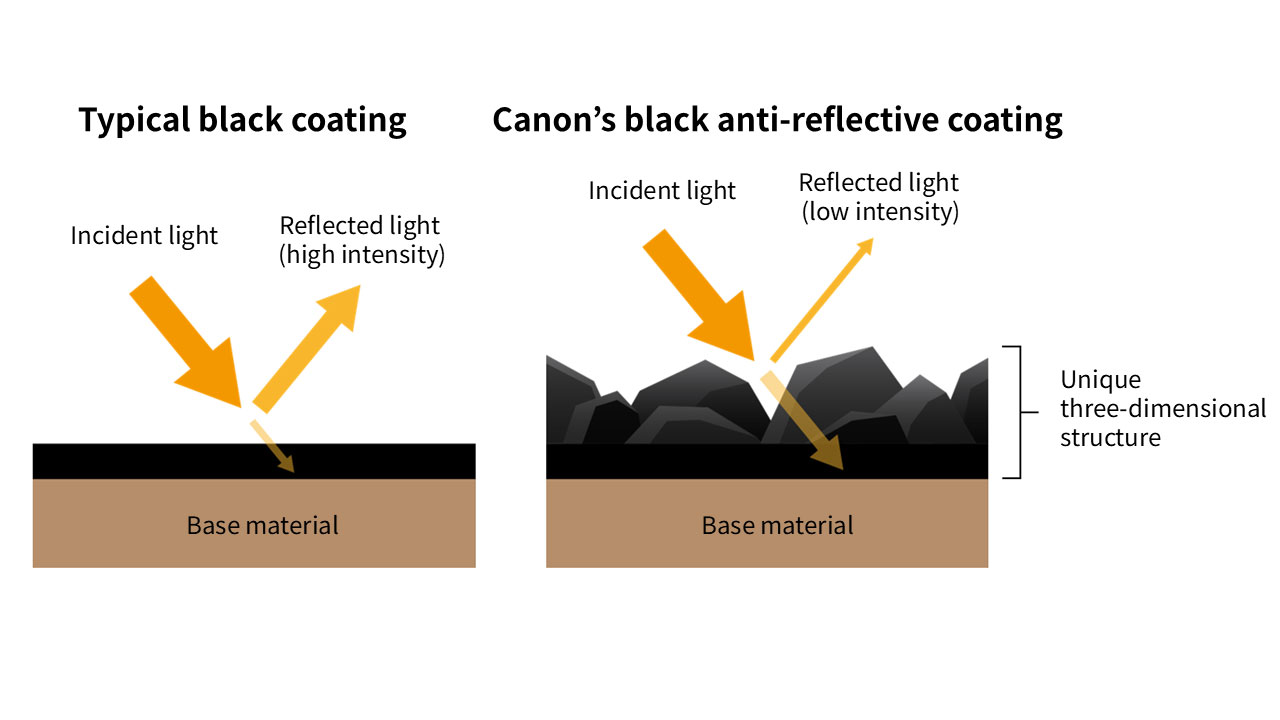
What sets Canon’s black anti-reflective technology apart is that Canon not only designed a structure that efficiently captures light, but also made it possible to form that structure through coating. These two achievements were made possible by combining Canon’s long-established expertise in optical and materials technologies.
When the coating is applied, Canon’s proprietary functional particles (fillers) form a three-dimensional structure that efficiently captures even light entering at oblique angles. The captured light is then absorbed by the coating, reducing the amount reflected from the surface.
Because simply applying the coating forms the three-dimensional structure, it can be used on objects with complex shapes and on a wide range of base materials, including metal, glass, and plastic.
Compared with methods that create a similar structure by processing the component surface, the coating method does not require specialized equipment or expensive materials and therefore offers potential cost advantages.
These features give the coating potential for use in a wide range of applications requiring both high performance and manufacturing efficiency.
Examples of possible applications
Canon’s black anti-reflective coating could help improve the reliability of detection and measurement by reducing stray light in a wide range of light-based devices, including cameras, sensors, and analytical instruments.
One area where this technology could prove particularly useful is advanced driver-assistance systems (ADAS) for vehicles.
For example, optical sensors such as onboard cameras and LiDAR* can be affected by strong sunlight or reflected light, potentially resulting in false detections.
Applying Canon’s coating to components surrounding the sensor could help suppress stray light and reduce the risk of such false detections.
In addition, applying the coating to components within the projection unit of a head-up display (HUD), which projects information onto a vehicle’s windshield, could reduce stray light within the device and improve the visibility of displayed information.
Other potential applications include optical sensors used in factory automation equipment, as well as projectors and a broad range of other devices that use light.
By reducing stray light, the coating could help reduce measurement errors and false detections, contributing to more accurate and reliable sensing and potentially improving the reliability of systems that depend on it.
Canon is working toward the practical application of this black anti-reflective coating in a broad range of optical sensing fields.
- * LiDAR (Light Detection and Ranging), a system that emits a laser beam and measures the distance to a target based on the time it takes for the reflected light to return.