
Journey
Advancing Intellectual Property Operations with Generative AINEW
Work Overview
Canon's Intellectual Property Division is transforming its workflows and operations through generative AI to improve the quality and efficiency of IP activities. IP work often involves reviewing, analyzing, organizing, and summarizing large volumes of documents, including patent specifications, office actions, cited references, contracts, and research materials. Generative AI is well suited to supporting these language-intensive tasks. By integrating generative AI into day-to-day workflows in ways that reflect the needs of IP professionals, we aim to improve both the quality and efficiency of our work.
How Canon’s IP Division Uses Generative AI
Simply introducing generative AI does not automatically produce meaningful results. The key is to identify the tasks for which it can provide real value and determine how best to incorporate it into actual workflows. The IP Division has established a cross-functional framework involving professionals responsible for patent prosecutions, patent searches, international filing, contracts, external IP matters, and administration. Through this framework, we explore potential use cases, share best practices, develop prompts (instructions for AI), and improve system functionality. Among these initiatives, we have placed particular emphasis on using AI to support patent drafting and prosecution.
Canon has a long-standing practice of drafting patent specifications in-house. Inventors from our R&D teams participate in the drafting process and patent prosecution process to some extent. As a result, both our IP and R&D teams have developed extensive expertise in articulating the essence of an invention and drafting appropriate claim language. Our objective in using AI is not merely to generate text more quickly. We are also exploring how AI can support the preparation of patent specifications, particularly patent claims, that meet the rigorous standards Canon has developed over many years.
An In-House AI Tool Designed for IP Operations
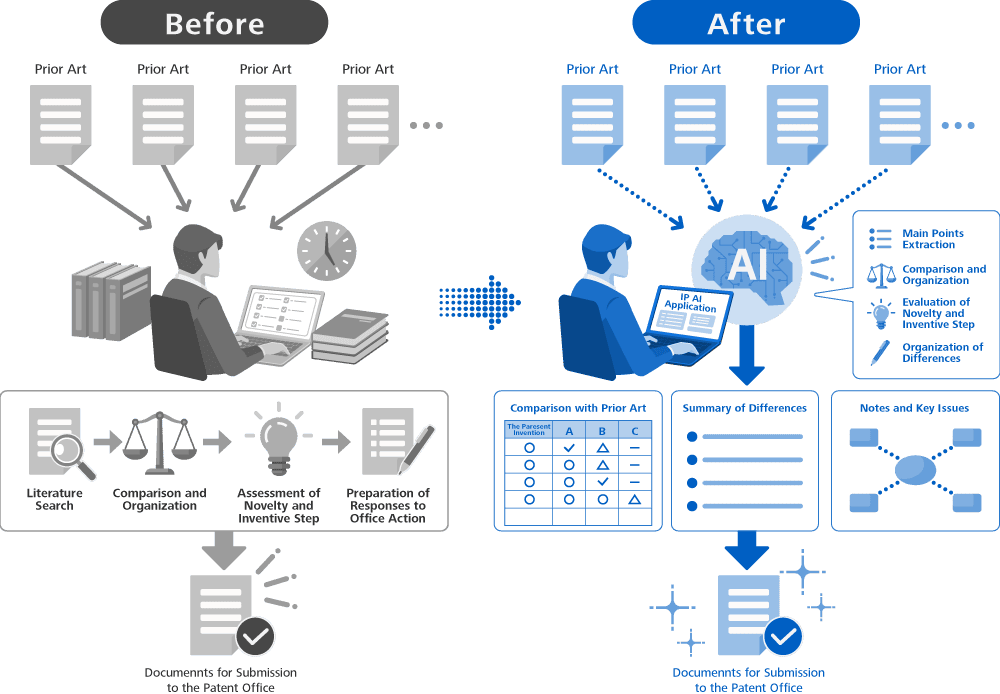
These initiatives are supported by an in-house AI tool developed specifically for the IP Division. During the development process, our IP professionals mapped out and formalized their own analytical and decision-making process. They also examined what information and instructions should be provided to the AI, and in what form, to obtain useful and relevant output. For example, when supporting the preparation of responses to office actions, the AI is provided with detailed instructions on the analytical process. These instructions specify how to structure the relevant information, the order in which to analyze it, how to compare the claimed invention with the cited references, and how to identify potential arguments in response to the examiner’s objections. Our patent professionals developed these instructions through repeated discussions in which they articulated the reasoning they apply when handling actual cases. Experienced staff also carefully review the AI’s output for omissions, errors, and unnatural wording. Based on these reviews, we continuously refine the prompts and workflows, helping to make the tool more reliable and effective in practice.
A key strength of our approach is that our efforts do not end with the introduction of the tool. Using it in day-to-day work reveals new issues and generates ideas for further improvement. User feedback leads to functional enhancements, which in turn allow the tool to be applied to additional use cases. This continuous cycle improves the effectiveness of our use of AI. Canon's approach combines the creativity and practical knowledge of its IP professionals with the in-house capabilities needed to turn their ideas into practical improvements.
Examples of AI Utilization at Canon IP
The in-house AI tool is used in the following areas:
(1) Drafting and Reviewing Patent Applications
Because of our long-standing practice of drafting patent specifications in-house, generative AI can provide valuable support in preparing and reviewing draft patent applications. The AI helps identify and organize the essential features of an invention, describe its technical configuration, suggest additional aspects that may need to be covered, and compare alternative wording. This enables IP professionals to further refine how an invention proposed by an inventor is described and claimed. Drafting appropriate claim language is particularly important. By optimizing the source materials, contextual information, and instructions provided to the AI, we seek to ensure that its output is closely aligned with the needs of patent professionals. Generative AI is also increasingly used by R&D teams as a sounding board during the stages of proposing inventions and organizing ideas.
(2) Analyzing Office Actions
During patent prosecution, we streamline the process of considering an amendment and counterargument strategy by inputting pending patent claims, an office action, and cited references into the AI to compare each claim and organize the key issues of the office action. Generative AI assists in organizing and analyzing relevant information, while our patent professionals review the results and make the final decisions. This combination supports the preparation of more thorough and well-reasoned responses.
(3) Analyzing Patent Filing and Technology Trends
Generative AI is also used to organize and categorize patent data and publicly available information for the analysis of filing trends and competitive landscapes in specific areas of technology. By structuring information and highlighting key points, the AI supports the analysis that can provide insights for business and R&D strategy. The batch-processing function of our in-house AI tool can apply the same analytical process consistently across large volumes of patent publications. This capability is useful when extracting specific information from patent publications or categorizing patents based on their content. It allows us to improve efficiency while maintaining the quality of our research and analysis.
(4) Supporting Contracts, Negotiations, and Dispute Resolution
Generative AI is also used to organize relevant information and identify key issues relating to contracts, negotiations, and disputes. By structuring large volumes of complex information and making it easier to share among stakeholders, the AI supports more timely and well-informed decision-making.
Skills Required of IP Professionals in the AI Era
As AI continues to advance, it can provide greater support for tasks such as document review, comparison, summarization, and drafting. At the same time, the role of IP professionals is evolving. In patent-related work, for example, it is increasingly important to determine what scope of protection should be pursued, what kind of patent portfolio should be developed, and how the resulting IP rights can be used to support business strategy. Canon's IP Division will continue to further strengthen its contribution to business strategy by developing professionals who combine traditional IP expertise with AI literacy, information analysis capabilities, problem-framing skills, and strategic thinking.