





Respecting Human Rights
Initiatives
Implementation of Human Rights Due Diligence
Based on the UN Guiding Principles on Business and Human Rights and the OECD Due Diligence Guidance for Responsible Business Conduct, we undertake human rights due diligence across the Group, as one of the activities under the Risk Management Committee. Each Canon Inc. division and Group company identifies and assesses the potential adverse human rights impacts in their respective business activities, including the supply chain, and identifies the salient human rights risks. The secretariat subsequently aggregates, analyzes, and evaluates the risks for the various organizations and, through stakeholder engagement, identifies salient human rights risks for Canon. In assessing human rights risks, we also refer to the human rights risk country/region index provided by the Responsible Business Alliance (RBA). Additional measures have been initiated to prevent or mitigate salient human rights risks identified by Canon Inc. divisions or Group companies where it is believed current actions are deemed insufficient.
We also assess human rights risks for new businesses. For example, when conducting an acquisition, we examine the target company's compliance with labor standards, health and safety laws, and other regulations as part of our due diligence. When launching a business with a new business partner, we also assess the risk of human rights violations for the partner.
In 2025, the organizations* selected by the Human Rights Secretariat were subject to human rights due diligence, and the implementation rate reached 100%. Canon will continue to reinforce efforts to prevent and mitigate human rights risks.
- * All business units (including related group companies), headquarters administrative divisions with a high potential impact on human rights risks, and other group companies (original-product‑owning companies and regional sales headquarters)
Drawing on Insights from External Experts
We are actively organizing dialogues with external experts to effectively implement human rights due diligence. By participating in human rights training programs hosted by the United Nations Development Programme (UNDP) and in seminars hosted by law firms, we gather information on current societal trends to use as a reference for our human rights response going forward. In 2025, we continued to take part in seminars and engaged in dialogue with experts, gathering information on human rights laws and regulations, including the EU Corporate Sustainability Due Diligence Directive, and are now considering our response.
Ongoing Monitoring
As mentioned above, Canon regularly verifies the status of compliance with the commitments stated in the Canon Group Human Rights Policy. We are also reviewing the Group's human rights initiatives in accordance with social demand, dialogue with stakeholders, and Canon's business operation.
Showcasing Canon's Human Rights Initiatives at a METI Training Program for Vietnamese Businesses
From February 27 to March 5, 2025, a Training Program for the Promotion of Responsible Business Conduct in Vietnam was held for Vietnamese companies that do business with Japanese companies or are considering doing so. The program was planned by Japan's Ministry of Economy, Trade and Industry. We introduced our human rights initiatives to the executives and managers of the Vietnamese companies taking part in the training.
Salient Human Rights Risks for Canon
We have identified 11 items as salient human rights risks that may arise in Canon's business activities, including the supply chain. These include discrimination based on factors such as race, gender, or religion; harassment; child labor; forced labor; unpaid wages/low wages; excessive overtime work; occupational health and safety; and protection of privacy. As shown in the table below, various measures are taken to prevent and mitigate these risks.
Salient Human Rights Risks for Canon
| Rights-holders | Measures taken by Canon | ||||
|---|---|---|---|---|---|
| Suppliers/ Contractors |
Canon employees |
Customers/ Consumers |
Local communities |
||
| Discrimination based on such factors as race, gender, or religion | ● | Diversity, Equity and Inclusion | |||
| Harassment | ● | Prevention of Harassment | |||
| Child labor | ● | Respect for Human Rights in the Supply Chain | |||
| Forced labor | ● | Respect for Human Rights in the Supply Chain | |||
| Unpaid wages/ low wages |
● | Respect for Human Rights in the Supply Chain | |||
| Excessive overtime work | ● | ● | Prevention of Excessive Overtime Work Respect for Human Rights in the Supply Chain |
||
| Occupational health and safety | ● | ● | Occupational Safety and Health and Productivity Management | ||
| Protection of privacy | ● | ● | Protecting Personal Information | ||
| Procurement of conflict minerals | ● | Addressing the Issue of Responsible Minerals Sourcing | |||
| Noise, environment pollution at operational sites | ● | Environment | |||
| Health damage or accident caused by product | ● | Product Responsibility | |||
Grievance Mechanism
Canon Inc. has set up an internal reporting system through which employees can report specific human rights concerns. We also work to raise awareness of the reporting system via the company intranet and training programs, among other measures, and are taking steps to ensure its appropriate use. Almost all Group companies in Japan and overseas have also established internal reporting systems to enable employees to report specific human rights concerns in local languages.
Canon Inc. also has a reporting system through which external stakeholders can report specific human rights concerns associated with Canon's corporate activities.
Both the internal and external systems give careful consideration to protecting the privacy of informants, such as allowing anonymous reporting, to ensure that informants are not treated unfairly for reporting.
For reports of potential compliance violations, we investigate the facts and ultimately determine whether a violation has taken place. Based on the findings, in cases where a compliance violation has been recognized, we take necessary measures to remedy the problem and prevent recurrence.
The table below indicates the number of reported human rights‑related whistleblowing reports, reported cases, and reported cases in which compliance violations were found, over the past three years. There was no case of serious human rights related compliance violation.
Reports, cases, and compliance violations(at year-end)
(no.)
| 2023 | 2024 | 2025 | |
|---|---|---|---|
| Reported whistleblowing reports during the year | 83 | 123 | 121 |
| Reported cases during the year | 94 | 140 | 141 |
| Reported cases in which investigations were completed and compliance violations were found | 17 | 27 | 29 |
| Discrimination, harassment | 14 | 23 | 25 |
| Labor management | 3 | 4 | 4 |
- * In cases where a single report contains multiple complaints, it is treated as one report and each complaint is counted as a separate case.
Human Rights Awareness Training
Canon since 2021 has been carrying out human rights awareness training programs for employees to instill basic knowledge about business and human rights and raise awareness of the Canon Group Human Rights Policy and other human rights initiatives at Canon. Training programs held overseas reflect national and local characteristics, with each company optimizing the content and translating it into each language.
Canon positioned this activity under the Risk Management Committee starting in 2025 and set a target of achieving a 100% implementation rate* for human rights education and awareness activities across the Group over the three-year period from 2025 to 2027. The rate as of the end of 2025 was 80%. We will continue to strengthen these education and awareness activities, aiming to further enhance the awareness of human rights among all employees.
- * Implementation rate at Group companies selected by the Risk Management Committee secretariat to undertake human rights education activities
Human Rights Training for All Employees at Canon U.S.A.
Canon U.S.A. offers human rights training to all employees. The training explains how modern slavery such as human trafficking and forced labor breach fundamental human rights, as well as the company’s commitments to respecting human rights and the responsibilities of managers and workers. It also covers how to recognize warning signs and apply best practices to uphold compliance.
Comment from an Employee from the Procurement Division Who Underwent Training
The training strongly reinforced that human rights risks, particularly modern slavery, can extend deep into the supply chain, which is a critical area for Procurement. I recognized the potential for hidden risks and gaps in regulatory or ethical compliance behind our first-tier suppliers. I plan to immediately incorporate the enhanced due diligence and red flag identification practices into our supplier qualification and ongoing monitoring, ensuring our contract language and future procurement processes proactively uphold Canon’s ethical sourcing commitments.

Procurement Division
Canon U.S.A., Inc
Stakeholder Engagement
The OECD Due Diligence Guidance for Responsible Business Conduct states that it is important for companies to engage with stakeholders at each stage such as when identifying and assessing the actual or potential adverse impact caused by corporate activities or when devising measures to prevent or mitigate such impact. In addition to the Canon Workers' Union, Canon is engaged in dialogue with institutional investors, suppliers, and business partners.
Stakeholder Engagement: Example 1 (Canon Workers' Union)
To identify and assess salient human rights risks and to consider measures for prevention, we organized dialogues with the union (in Japan) relating to issues that represent human rights risks for employees, including discrimination based on factors such as race, gender, or religion; harassment; excessive overtime work; occupational health and safety; and protection of privacy. Through dialogue, we identified trends in corporate responses to human rights issues and are exchanging opinions on a wide range of concerns, including the active participation of women in the workforce, issues involving lesbian, gay, bisexual, transgender, and queer (LGBTQ+) persons and persons with disabilities, and consultations about harassment and efforts to address these issues, as well as concerns about employee career development and telework and other types of flexible work styles. The results of these discussions are taken into consideration when we identify and assess salient human rights risks for Canon and consider preventive measures.
Stakeholder Engagement: Example 2 (Business Partner, Industrial Equipment)
Canon develops, manufactures and sells semiconductor steppers and other industrial equipment on a global basis. One of the salient human rights risks in the industrial equipment sector is the risk of accident or worker injury to employees of Canon or subcontractors during the transport or the installation of equipment. The massive size and mass of these systems means that any lack of OHS care could result in a serious accident such as being caught in machinery or falling from a height. As well as taking steps to prevent injury to its employees, Canon Inc. regularly discusses safety issues with delivery/installation subcontractors, including examples of near-misses and rule violations, and related problems.
Our Respect for the Human Rights of Employees
Evaluation & Improvement of Human Rights Risk-related Activities at Canon Group Production Sites
In 2025, Canon completed a human rights risk assessment at 64 Canon Group production sites in Japan and overseas using the RBA's Self-Assessment Questionnaire (SAQ). Through this assessment, Canon confirmed that there were no cases of child labor or forced labor, and verified the actual conditions regarding worker's freedom of association and collective bargaining rights.
Regarding the actual conditions identified to date through our risk assessments, we have implemented the following improvements.
- Made regulations clearly state that the company will not retain originals of personal ID documents or other personal documents
- Conducted evacuation drills when it is dark outside
- Established a framework for giving reasonable
In addition, Canon conducts internal audits, including on-site inspections, and undergoes regular external audits. In 2025, 9 sites worldwide underwent Validated Assessment Program (VAP) audits, a third-party auditing program of the RBA. The number of sites holding valid certification as of the end of December 2025 is as follows:
Sites with RBA VAP Audit Certification*(as of end-December 2025)
| Number of ranked sites | |
|---|---|
| Platinum | 14 |
| Gold | 4 |
| Silver | 7 |
- * Includes sites that underwent VAP audits and obtained certification in 2024
Facilities audited in 2025 received feedback including in the following areas and are taking corrective measures:
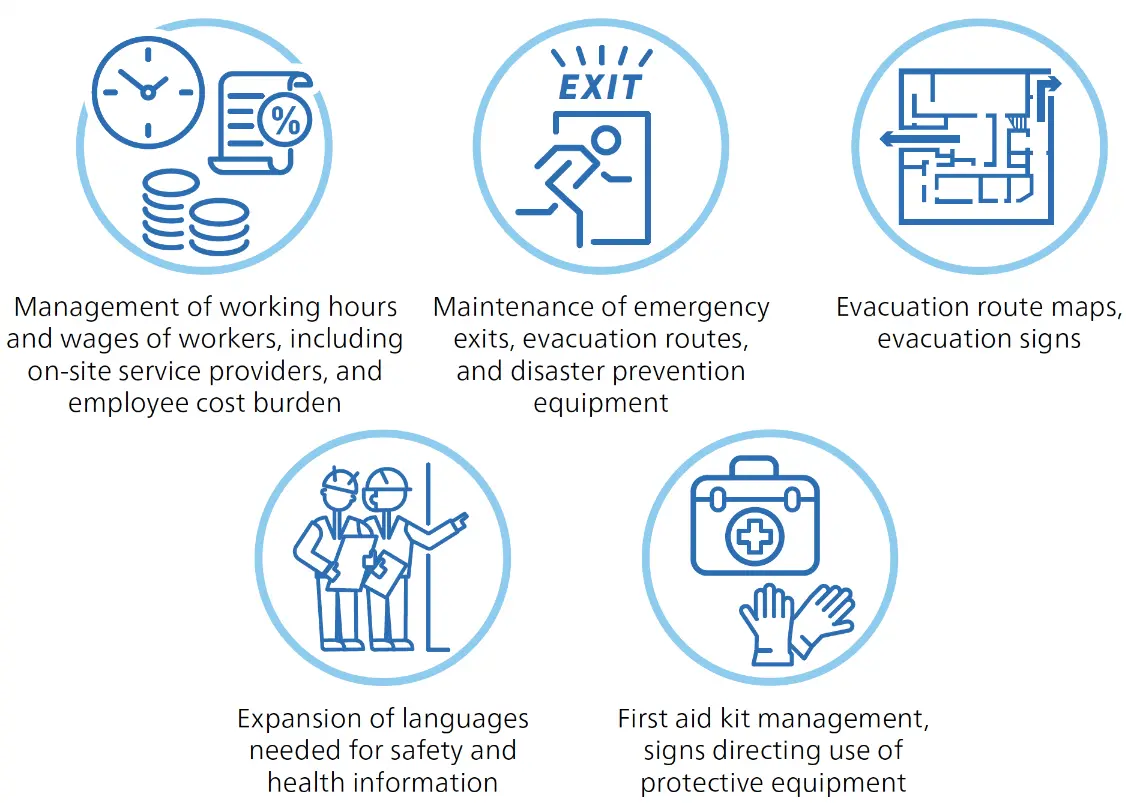
Improvements Made Following the 2025 VAP Audit
Prevention of Child and Forced Labor and Unreasonable Restrictions on Movements
We use the RBA's SAQ at Canon Group production sites in Japan and overseas. Based on the survey responses, we confirm that there is no evidence of child or forced labor or any unreasonable restrictions on workers' movements on the site or while at work. In addition, to mitigate the risk of forced labor, we have confirmed through the SAQ that Group companies do not retain originals of employee personal ID documents or other personal documents, and that they have put regulations in place that clearly stipulate this.
To prevent child labor, we thoroughly check the age of employees when they enter the company, and we have developed a response flow in case an employee who is under the minimum working age is found. In addition, young workers under the age of 18 are prohibited from working any overtime or night time, or engaging in dangerous work, thereby giving consideration to their health.
Prevention of Excessive Overtime Work
We have instituted a system to accurately ascertain the working hours of employees at production sites in Asia deemed to be subject to a notably high risk of excessive overtime work. Actual results on working time management, including overtime work, are reported annually to the HR division of Canon Inc. Work guidelines were introduced to Canon Group production companies based in Asia in 2015 as part of human rights risk-related initiatives. In 2022, we overhauled these guidelines to make them consistent with RBA standards, extending them to all our domestic and overseas Group production companies.
Respect for Freedom of Association and the Right to Collective Bargaining
As stated in the Canon Group Human Rights Policy, Canon respects freedom of association and the right to collective bargaining. We also strive to address various labor issues by promoting dialogue between labor and management. For example, the labor agreement between Canon Inc. and the Canon Workers' Union commits both sides to work in good faith to peacefully resolve issues in a timely manner.
Prevention of Harassment
In line with the principle of respect for humanity that Canon has followed since its foundation, Canon not only prohibits discrimination on such factors as gender or occupation, but also maintains a zero-tolerance policy on harassment, which it communicates to all management executives and employees. In addition to sexual harassment and abuse of authority (power harassment), Canon Inc.’s employment rules and Harassment Prevention Provisions prohibit other forms of harassment, including maternity harassment. These provisions have been disseminated throughout Group companies in Japan, and many have instituted similar rules based on them. In a further effort to maintain a comfortable workplace environment, Canon Inc. and its many Group companies in Japan have established a Harassment Hotline. Confidentiality surrounding employee consultations is strictly maintained and a firm guarantee against unfair treatment is provided to victims and informants. In terms of preventing harassment, regular liaison meetings are held for persons responsible at Canon Inc. operational sites and Group companies in Japan, enabling the operational status of hotlines to be monitored and shared. Meeting participants review procedure manuals and share knowledge on how to respond to reports of harassment.
Additionally, to address the diversification of values resulting from recent changes in work styles, lifestyles, and communication methods, it is important for each employee to have a proper, common understanding of harassment. We carried out an e-learning program on preventing harassment for all employees of Canon Inc. in 2024. Furthermore, from 2025, we have been enhancing our training content and gradually rolling it out to our domestic Group companies.
Respect for Human Rights in the Supply Chain
Canon joined the RBA in 2019, with the aim of strengthening our initiatives for social responsibility within the supply chain, and formulated the Canon Supplier Code of Conduct, based on the RBA Code of Conduct. We communicate the Canon Supplier Code of Conduct to suppliers and also request the parts and materials suppliers of our main business products (major suppliers), to sign a compliance agreement on the RBA Code of Conduct. The RBA Code of Conduct has been translated into over 20 languages, including English, Chinese, Japanese, Thai, and Vietnamese.
In line with our support for the Keidanren-led Declaration of Partnership Building initiative, Canon is also committed to cooperation and co-existence with business partners and strives to avoid unreasonable requests for cost reductions, orders with short turnarounds that do not reflect appropriate cost bearing, and requests for sudden changes in specifications. We also make efforts to set prices that take into account the impact of higher labor costs.

A coalition of companies promoting socially responsible global supply chains
| Canon Sustainability Supplier Guidelines (255KB) |
Risk Identification and Assessment for Parts and Materials Suppliers
We request that major suppliers conduct annual selfassessments using the RBA-approved SAQ to identify, evaluate, and prevent human rights risks at suppliers, such as child labor, forced labor, unreasonable restrictions on movement, or excessive working hours.
After assessing and analyzing SAQ responses received from suppliers, we provide feedback and request improvements as needed. For some suppliers, we also conduct online meetings and on-site inspections to verify their SAQ responses. We confirm that suppliers have put internal regulations and systems regarding human rights in place, working to strengthen the framework for compliance with the Canon Supplier Code of Conduct across the supply chain. The following are examples of matters we verified in 2025 to confirm compliance and propose improvements:
- Regulations for establishing reporting channels and their implementation status, and we provided advice to suppliers whose regulations did not clearly state that anonymous reporting was possible.
- Notices of working conditions in the native languages for foreign employees are being presented and implemented.
- Regulations regarding harassment prevention are in place and awareness‑raising measures such as posting notices and distributing pamphlets are implemented.
- Necessary health and safety permits and licenses are fully obtained and submitted, and updated as appropriate.
- Safety measures for machinery and inspection rules, as well as the maintenance of evacuation routes and disaster prevention equipment at manufacturing sites.
Assessing and Identifying Risks for On-site Service Providers and Labor Agencies
Since 2022, we have also been carrying out risk assessments relating to labor, health and safety, the environment, and ethics for major on-site service providers contracted by our core business production sites, including security, cleaning, and food service, labor agencies, and facility or dormitory management companies. We have worked in collaboration with suppliers to address the risks identified to date. The following are specific examples:
- We verified that employees were being charged for essential work items such as uniforms and tools, and requested improvements accordingly. We subsequently confirmed that the collected amounts were refunded to employees and that the system was revised.
- Company regulations stipulating the imposition of fines and pay cuts as disciplinary measures were being applied, so we requested that the regulations be revised and confirmed that they had been.
- Since short-term workers were not provided with pay slips that clearly stated their working hours and wage rates, we advised the company to create and provide more detailed wage statements.
- We instructed a company to ensure that the transportation of heavy objects of a certain weight or more is carried out by two or more people, and confirmed that pregnant women were not engaged in such tasks.
- As measures to restrict access to personal information were not in place at a supplier, we requested that a framework be established to manage access and confirmed that password-setting and other rules were put in place.
Comment from an Employee in Charge of an On-site Supplier Inspection
Managing the supply chain is a highly complex challenge, but we believe it is important to protect workers' rights and ensure safe and fair working conditions. At Canon, we work every day to ensure the Canon Supplier Code of Conduct is implemented not only in our own operations but throughout our supply chain together with our suppliers.
After collecting and confirming SAQ responses from suppliers, we conduct on-site inspections and examine the responses for the RBA elements: Labor, Health and Safety, Environment, Ethics, and Management Systems. When a risk is identified, we work closely with the supplier to understand the situation and implement corrective actions. Even for answers identified as low risk, we verify their reliability and, when necessary, review supporting documents that substantiate them.
Through this communication, our initiatives have been highly valued by suppliers, leading to stronger partnerships aimed at continuous improvement of working conditions. Looking ahead, we will continue working with our suppliers to create positive change and build a more sustainable future.

Purchasing Control
Canon Business
Machine (Phils), Inc.
Compliance with Modern Slavery Act
Based on the laws and regulations of each country, such as the UK's Modern Slavery Act 2015, Australia’s Modern Slavery Act 2018, and Canada's Supply Chains Act, Group companies subject to such laws publish statements outlining their policies and efforts to eliminate human trafficking, forced labor, and other illegal activities from their supply chains.