
Future
Strategies for Canon Intellectual Property Activities
- To continue to win -
In Canon's IP activities, in order to continue to win the battles in front of us, We have been practicing offensive and defensive IP operations from a long-term perspective, anticipating technologies and businesses to come.
To implement these, our basic strategy is to carry out a so called open/closed strategy that inter-relatedly combines the following three elements to continue to win.
- 01.Patents related to core
competence
technologies - 02.Patents related to
general-purpose
technologies - 03.Inventions that others
cannot
easily make
- 01. ▶Patents that protect our business in competitive domains, will not be licensed, but will be used to secure our competitive advantage.
- 02. ▶Patents such as communications and GUIs, in the cooperative domain, will conclude a cross-license agreement, to secure freedom in our R&D and business.
- 03. ▶Inventions that others cannot easily make are kept secret and protected as know-how, so that competitors are not able to emulate us and our competitive advantage is secured.

Promotion of intellectual property activities
Starting with the NP system of electrophotography in the 1960s, Canon's defensive intellectual properties, such as bubble jet, interchangeable lenses, consumables, and production engineering technology, have been the bases of our current businesses for many years, while our offensive intellectual properties have greatly assisted our response to the computerization and digitization of cameras and printers. These have contributed to the development and expansion of our businesses.
Although these basic concepts of IP activities have been handed down unchanged, our IP strategies and tactics have changed with the times. For example, competitors in the camera market are rapidly changing, and IT companies that do not compete with Canon in business but do compete in patents have emerged.
Along with these developments, industries that use common IT technologies, such as automobiles and housing, have also expanded. This results in a wide expansion of the range of parties with whom we have to negotiate on intellectual property issues.
We need to innovate and evolve our litigation and negotiation strategies to keep up with the times, and to prepare various tactics to battle flexibly according to the opponent. To this end, Canon will carry out intellectual property activities to keep renewing our patent portfolio as a weapon, in line with our business portfolio and the changing times.
Canon is now trying to jump-start four new businesses: commercial printing, network cameras, medical devices and industrial equipment. We are also focusing on the creation of future businesses such as the Free Viewpoint Video System, next-generation imaging such as XR, next-generation healthcare, smart mobility and so on. To ensure the sustainable development and growth of these new businesses, the Intellectual Property Division not only applies for patents and obtains rights for the core competence technologies, but also applies for patents and obtains rights for technologies in various fields with an eye to the future to maintain a strong patent portfolio.
As a result of mergers and acquisitions, many patents that will become the core of new businesses have been created by group companies. We will enhance synergies with the intellectual property activities of Group companies in Japan and overseas, solidify the foundation of our intellectual property activities of the Canon Group, and strengthen the Group's portfolio.
The world has entered the era of the "new normal" and digital transformation (DX), and technologies essential for cyber-physical systems (CPS) incorporating AI and IoT are becoming more and more important. We must also work to solve social issues such as SDGs, taking a long-term perspective. Regardless of whether they are new or existing, Canon's products and services need to be organically linked to CPS and social issues. Accordingly, we will step up our efforts to create and utilize standard-essential patents such as those for image data compression, wireless communication, and wireless power supply in IT-related fields, as well as implementation patents used in products based on standardized technologies.
We will also work hard on intellectual property for sensors, actuators, displays, and user interfaces (UIs), which are the entry and exit points for cyber-physical space, as well as the systems that use them. We will take a long-term perspective and strengthen our initiatives more than ever for environmentally friendly technologies such as energy conservation, recycled materials and manufacturing methods that reduce waste.
In collaborative domains and domains related to social issues, we will not only create patents, but also use intellectual property to create new value, making use of our designs, trademarks and brand power and forming alliances with suppliers and users.
As Canon Group, we will make the best use of our intellectual property to secure competitive advantages and freedom for our businesses, and at the same time continue to contribute to creating a better future society with products and services that have high added value or create new value.
IP Activities in Phase VII of the Excellent
Global Corporation Plan
Under the Excellent Global Corporation Plan Phase VI (2021-2025), Canon has set a goal of strengthening the competitiveness of the printing, medical, imaging and industrial groups, and is also focusing on creating future businesses such as commercial printing, industrial printing, next-generation healthcare, advanced surveillance, next-generation semi-conductor manufacturing and digital solution services. In order for these businesses to develop and grow, Canon's IP division has been focusing on the creation and acquisition of intellectual property rights related to core competence technologies such as optical technology, video processing, and analysis technology, technologies for cyber & physical systems incorporating AI/IoT, standard technologies, environmentally friendly technologies, and other areas. Under Phase VII of the Excellent Global Corporation Plan (2026-2030), Canon will systematically implement intellectual property activities to support the expansion of its business domains.
Printing Providing value through cyber/physical systems
In addition to the commercial printing and industrial printing fields, Canon is creating intellectual property that supports cyber & physical systems that work with various equipment, including office equipment. In addition to the basic technologies for the controllers and engines commonly installed in various printer models and the basic technologies for the cloud that provides added value to printers, Canon is building a patent portfolio related to technologies that respond to the coming era, such as environmentally friendly printer technologies and new printing solutions utilizing artificial intelligence.
Medical Providing new value to clinical settings, enhancing competitiveness and expanding business domains
Canon has built an intellectual property portfolio that protects technologies that create new value, such as AI solutions that support the realization of precision medicine (individualized medicine), photon counting CT that is expected to improve diagnostic accuracy and reduce exposure dose compared to conventional equipment, and other technologies that are continuously provided to medical sites. In addition, through collaboration among group companies, the Group is combining its accumulated technologies, such as optical technologies and image processing technologies, with diagnostic imaging technologies and solutions unique to the medical field, and strengthening its intellectual property portfolio that supports business expansion into new domains such as healthcare IT and bioscience with diagnostic imaging as its core.
Imaging From cameras to the imaging business
In the fields of mirrorless cameras, video cameras, surveillance cameras, and other products, Canon is creating intellectual property by focusing on video-compatible technologies, network technologies, and AI application technologies that use machine learning to recognize subjects and their movements in addition to advanced optical technologies. In addition, the Group is strengthening its patent portfolio in the areas of next-generation entertainment and social safety and security, including 3D imaging technologies such as Volumetric Video and XR, and SPAD sensors that can capture subjects with clarity even in the dark over a few kilometers.
Industrial Rolling out an array of manufacturing solutions for the electronics industry
In addition to the production equipment such as lithography equipment, die bonders, organic electroluminescent display production equipment, and sputtering equipment, Canon is also focusing on the creation of intellectual property related to manufacturing solution services such as Lithography Plus. In addition, the Company is strengthening its patent portfolio for Raman spectroscopy technology, which enables the recycling of black plastic, and Nanoimprint Lithography technology, which realizes low power consumption, and supporting the expansion of new businesses.

Constructing patent portfolios
Canon identifies emerging social and economic trends from various changes and developments in the business landscape and invests considerable resources into acquiring IP rights connected to our business core competencies as well as IP rights that anticipate future business trends. In parallel with this, we regularly review the value of our patents and update the rights we hold to maintain a powerful patent portfolio.
-
Example 1: CT technology
We have been growing our patent portfolio for CT, in order to achieve the global No.1 position in our existing business, to establish an advantageous patent balance against our competitors, and to protect key future technologies. Also, in recent years, the focus of our IP activities is expanding, with the advent of AI-powered image enhancement technology and photon-counting CT. CT patent portfolios

*Compiled by Canon using PatentSight® data of LexisNexis Data based on IPC (International Patent Classification) A61B6/03
*Number of surviving patent families held by the Canon Group at each year-end (number of published families that are either registered or pending) -
Example 2: SPAD sensor
Canon is utilizing its newly developed SPAD sensor technology to expand its business into the fields of remote surveillance and night vision. An ultra-high-sensitivity camera equipped with this SPAD sensor and Canon’s extensive expertise in high-magnification super-telephoto zoom lenses, can vividly capture objects even in the dark of night. It can quickly detect accidents or disasters at ports, along coastlines, and at public infrastructure facilities. Moreover, due to their high sensitivity and high-speed imaging capabilities, we expect to see heightened demand for SPAD sensors across a wide range of applications, including medical, communications, and autonomous driving. Canon is further accelerating the development of SPAD sensors, which hold promise for such new business opportunities, and is expanding its patent portfolio related to SPAD sensors year after year.SPAD sensor patent portfolio

*Compiled by Canon using PatentSight® by LexisNexis
* Number of surviving patent families held by the Canon Group at each year-end (number of published families that are either registered or pending) -
Example 3: Nanoimprint Lithography
For more than a decade, Canon has been pursuing R&D in the field of nanoimprint lithography, a new semiconductor manufacturing process. Alongside our long-term R&D, we have been building a robust patent portfolio for innovations ranging from elemental technologies in the optics and materials fields to equipment technologies and semiconductor manufacturing processes. As of December 2024, we led the world in the number of patents held in this field. Our objective from the outset has been commercialization, and the nanoimprint semiconductor manufacturing equipment we launched in 2023 is protected by this patent portfolio.Nanoimprint lithography patent portfolios

*Compiled by Canon using PatentSight® by LexisNexis based on CPC (Cooperative Patent Classification) G03F 7/0002
*Number of surviving patent families held by the Canon Group as of April 24, 2025 (number of published families that are either registered or pending) -
Example 4: AI-based video/image processing
Regarding video and image processing which are positioned as Canon's core technologies, we are discovering and developing new technologies based on our existing technology assets.
For example, as of June 2025, we ranked seventh globally for numbers of patents owned in AI-based video/image processing (on active patent - families basis).
These kinds of elemental technologies are leveraged to create new technologies for image recognition in the Imaging Group or diagnostic imaging in the Medical Group, thereby contributing to the realization of better products and services.Global ranking for imaging-related machine learning / AI patent registrations
*Compiled by Canon using PatentSight® by LexisNexis based on data from ip-search as provided by the Swiss Federal Institute of Intellectual Property using International Patent Classification tech fields H04N and G06T
*Number of surviving patent families held by the Canon Group as of June 12, 2025 (number of published families that are either registered or pending) -
Example 5: Standardization Activities
Canon continues to contribute to the development of global technologies via active participation in standard setting organizations, utilizing not only domestic expertise but also the expertise of overseas researchers in these fields. The many inventions relating to our technical contributions continue to expand our standard essential patent portfolio. Canon focuses on technology regions such as mobile communication (5G,6G), wireless LAN (Wi-Fi, etc.), video encoding (HEVC, VVC, etc.), and wireless power transfer (Qi, etc.). The more our patents relating to next-generation technical standards are adopted in various products and services of many companies, the more the value of our patents increases, and consequently our IP competitiveness continues to grow.Ranking by Number of Patents Registered in HEVC Patent Pools
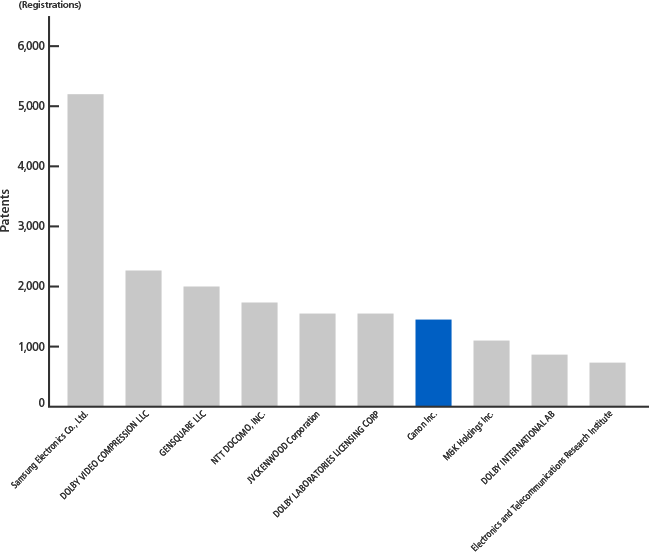
*Compiled by Canon based on data from ViaLA(May 2026) and AccessAdvance(April 2026).


Trademarks and Design rights practice
Canon handles the tasks related to trademarks and design rights in a single department. This trademark and design department not only deals with the filling of trademarks and design rights but also monitoring and watching the latest technologies such as NFTs, metaverse spaces, AI creations, as well as trends in related laws such as copyright and unfair competition prevention. The department works closely with other intellectual property departments in various locations around the world to maximize Canon brand value.
Global governance of trademark
The Canon logo, conceived in 1935 as a "globally recognized trademark," The Canon logo has been registered as a trademark in over 190 countries and regions. Canon promoted the protection of brand by establishing a global trademark management policy in the early 2000s Now many other Japanese companies are exploring the establishment of global intellectual property governance that contributes to company management, prompted by revisions to corporate governance codes in recent years.
In China, Canon recognized early on the importance for brand penetration of using Chinese characters and since 2006 we have been using the Chinese character 佳能 (read as “jiānéng”) in addition to the Canon logo in roman characters as a company brand representation.
The pleasant sound and meaning of 佳能 in Chinese have led to a number of similar trademark applications by third parties. However, Canon protects its brand and consumers by filing around 50 formal objections in China each year to such trademark applications. Our successes in protecting our trademarks in Asia have attracted positive recognition and earned us the title of Technology and Consumer Team of the Year in the 2023 awards granted by World Trademark Review, a multimedia publication by Law Business Research.
Canon Design Identity
In Canon Design Center, we have set out a concept known as “Canon Design Identity” aimed at improving brand value by coordinating designs across different product genres and in turn generating high-quality designs. In order to ensure that our products embody this concept, Canon Design Center articulates Canon’s distinctive personality and conducts weekly reviews to ascertain whether there is scope to increase design quality. The trademark and design department shares the Design Center’s awareness of the Canon Design Identity and how it shapes the Canon brand and members of the department follow the same approach as they apply for and acquire design rights.
Promoting the IP MIX Strategy
We are actively promoting an IP MIX strategy, which combines multiple forms of intellectual property, such as patents, design rights, trademarks, know-how, and copyright, to protect our products and services. Therefore, our trademark and design patent specialists collaborate not only with the business units and designers but also with the R&D divisions and patent teams. Canon’s IP divisions adopt the approach of engaging in a wide range of activities rather than focusing excessively on one particular type of intellectual property.
As one example, we focus on graphical design rights as a means to protect the user experiences and user interface designs supported by our unique technology. Graphical design rights are a newly introduced category of design patent protection in Japan. Unlike patents, design rights allow for the protection of the design itself. As we apply for and acquire such rights, we are conscious of the need to protect one product in various ways—which naturally includes securing patents to protect the user experiences that are grounded in technology, but also applying for graphical design rights of the supporting graphic design and of the very design of the graphic user interface that seeks to ensure accessibility for users.
We envision what kinds of design rights will be effective tools for utilizing in business five or ten years from now and seek to apply an open-minded approach to generating ideas.
Example of graphic design rights: Level measuring graphic (Design right registration no. 1731392)▼
-

Drawing -

Example reference graphic image view of use

